The Hamilton Puzzler The Continental Conundrum The Befuddled Blue
Solutions Page for Logic Puzzle #5: The Self-Referential Crossword Puzzle (March 2009)
The winner of the fifth logic puzzle contest is:
Tongxin Lu ' 11
Congratulations to her! And, thanks to all of you who sent solutions!
Other fully correct grids were submitted by:
Kathryn Kroleski '09, Jessica Smith '09, Andrew Taub '12, and Alex Wood '12
and
Shoshana Brassfield (Philosophy)
Click to go to:
The Puzzle
The Completed Grid
An Extended Walk-Through, with Tables
The next puzzle will appear on April 9, 2009.
Logic Puzzle #5: The Self-Referential Crossword Puzzle (March 2009)
Self-referential sentences have long puzzled philosophers. Epimenides’ 6th century B.C. poem Cretica, contained the line:The Cretans are always liars, evil beasts, slow bellies.
Epimenides himself was from Crete. If we interpret his claim as meaning that all Cretans lie all the time, then his statement, if true, entails that it is false; and if it is false, then it must be true.
The so-called Epimenides paradox is most simply presented in a form called the liar: “This statement is false.” The liar was well-known in ancient and medieval times. The epitaph of the third-century poet Philetus reports that he died worrying about it:
Philetus of Cos am I/ ’Twas The Liar who made me die/ And the bad nights caused thereby.
Bertrand Russell’s paradox for set theory, discovered in 1901, relies on considering the set of all sets that do not contain themselves. Russell’s paradox, which devastated Gottlob’s Frege’s attempt to reduce mathematics to logic, spurred a century’s worth of research on the foundations of mathematics. Today, the liar and other self-referential sentences are hot topics in philosophy and logic journals because of their ramifications for mathematics, language, and metaphysics.
Every entry in the self-referential crossword puzzles below contains a number spelled-out, followed by a blank space, a letter, and an ‘S’ where a plural is appropriate. All entries accurately describe the completed puzzle. Here is a simple puzzle, and its solution.
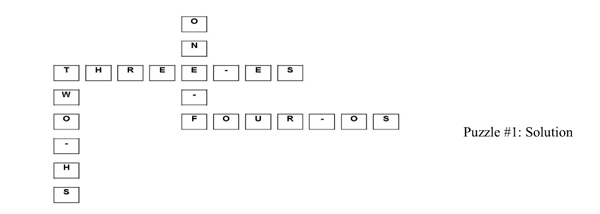
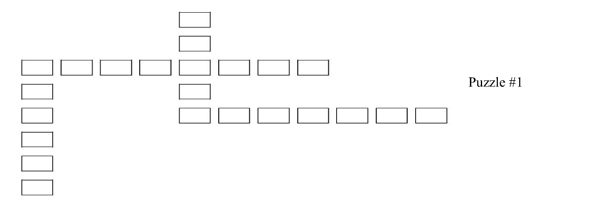
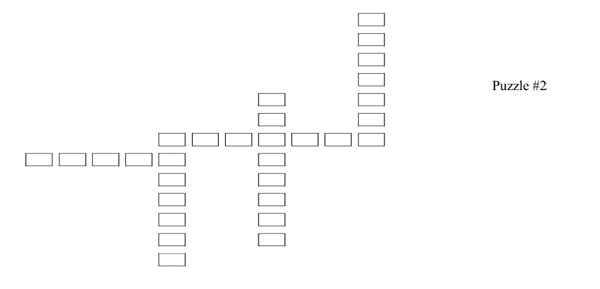
Note that the solution to Puzzle #1 contains the (lower horizontal) entry ‘Four Os’; there are in fact four ‘O’s in the puzzle. There is also one ‘F’, three ‘E’s and and two ‘H’s, just as the other entries say. Here is another simple puzzle, for you to complete.
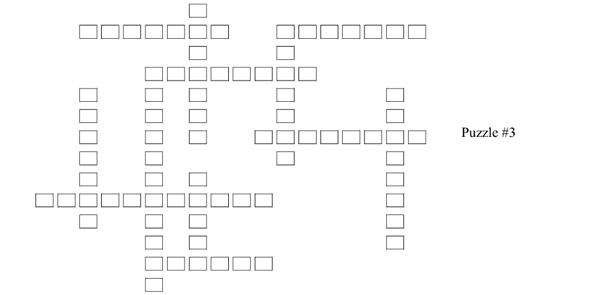
Call one of these self-referential puzzles complete if, for every letter token in the puzzle, there is an entry which states how many instances of that letter type appear in the completed puzzle. Thus, if there are any ‘Z’s in the puzzle, there will be one (and only one) entry which states exactly how many ‘Z’s there are. The following puzzle is complete. I believe that it is the only complete one of its type possible. (While there is only one entry for each letter, some numbers may appear more than once.)
The Completed Grid
An Extended Walk-Through, with Tables
Back to top
The Grid:
Here is a completed grid. If it is too difficult to read, you can download an easier-to-read pdf.
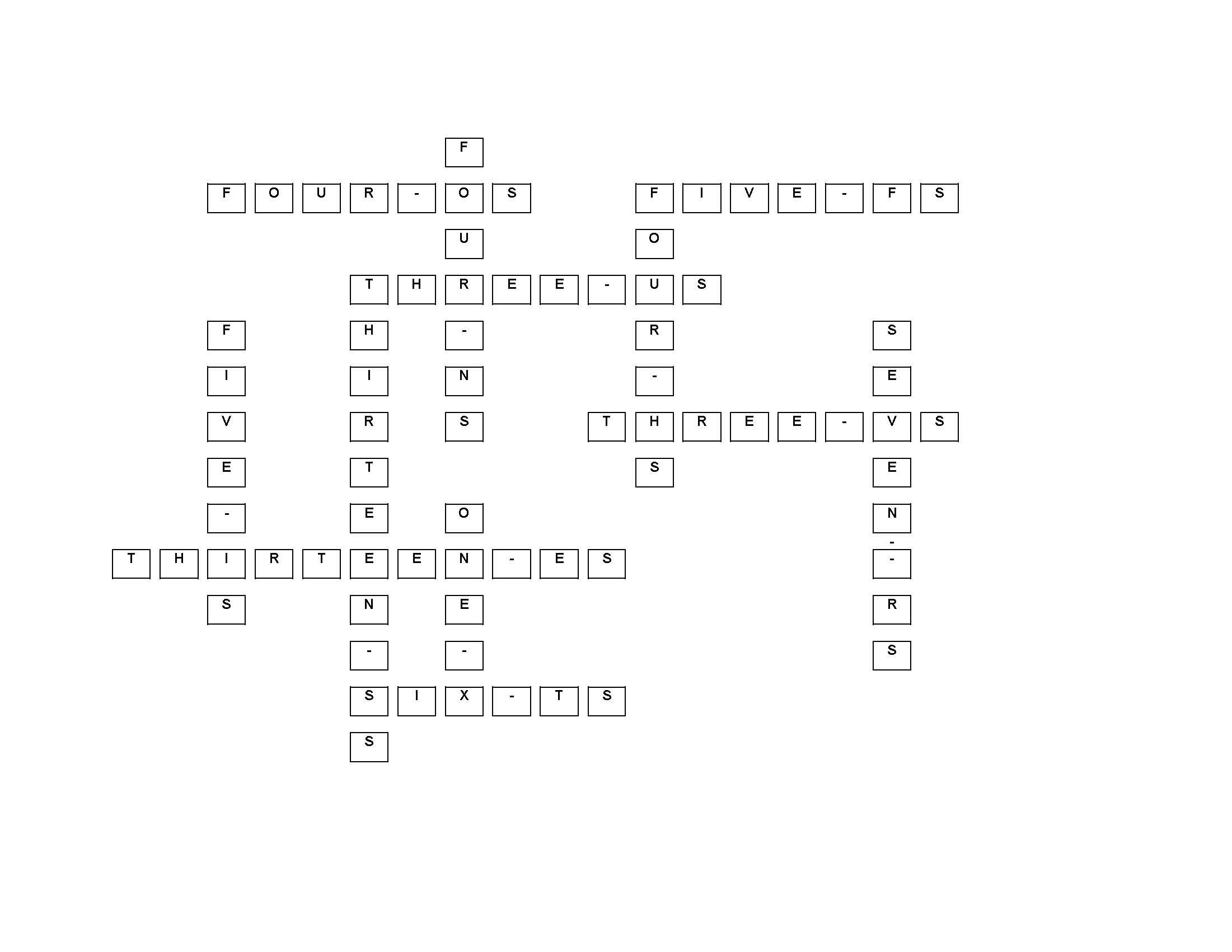
Here is an extended walk-through
An Extended Walk-Through, with Diagrams
I suggest you print a grid, and fill it in as you read the following solution.
Since there are twelve entries, there will be twelve entry letters. One key task to solving the puzzle will be to determine the twelve entry letters.
There are one five-space entry, one six-space entry, five seven-space entries, three eight-space entries, and two eleven-space entries. The five-space entry must include a ‘one’, and no plural ‘s’. All other entries will contain three spaces in addition to the number word: a blank, the entry letter, and a plural ‘s’. The six-space entry will include a three-letter number word, the seven-space entries will contain four-letter number words, the eight-space entries will contain five-letter number words, and the eleven-space entries will contain eight-letter number words. So, the following lists will be useful:
Three-letters number words: one, two, six, ten
Four-letters: four, five, nine
Five-letters: three, seven, eight
Eight-letters: thirteen, fourteen, eighteen, nineteen
No other number words until fifty have three, four, five or eight letters, and it quickly becomes clear that there will be fewer than fifty of any given letter in the completed grid.
We start with the five-letter entry, filling in a ‘one’, though we do not know which letter is described. We do know that it can not be an ‘n’, ‘o’, or ‘e’, because writing it would create two of those letters. Thus, the six-letter horizontal entry which contains the described letter and which must contain a three-letter word, can not have an ‘n’, ‘o’, or ‘e’ in its third space. That is, it must have a ‘six’, which we can fill in.
We now know that six of the twelve entry letters are ‘o’, ‘n’, ‘e’, ‘s’, ‘i’, and ‘x’. We need to find six more.
Consider the vertical entry which contains the ‘s’ from ‘six’. That entry will describe the number of ‘s’s in the puzzle. Let’s fill in all the plural ‘s’s for all the entries in the puzzle. We now have twelve ‘s’s in the puzzle.
The vertical entry which describes the number of ‘s’s must contain one of the eight-letter number words. Also, its first letter must be the first letter of a five-letter word which will go in the horizontal entry which shares that first space. So, there must be either ‘thirteen’ or ‘eighteen’ ‘s’s in the puzzle. We already have twelve ‘s’s. The only way to add more ‘s’s is to write ‘seven’ in the eight-space entries. There are only three eight-space entries, so there is no way to get eighteen ‘s’s into the puzzle. So, there must be thirteen ‘s’s in the puzzle. We can fill in the vertical entry which says so. Remember that since we have twelve ‘s’s already in the puzzle, we will have to add one ‘seven’, in one of the eight-space entries, to get our thirteen ‘s’s.
We now know that ten of the twelve entry letters are ‘o’, ‘n’, ‘e’, ‘s’, ‘i’, ‘x’, ‘t’, ‘h’, ‘r’, and ‘v’. (The ‘v’ comes from the ‘seven’ we will add later.) We need to find only two more letters.
The horizontal entry which shares the first ‘t’ in ‘thirteen’ must contain a ‘three’, since that is the only five-letter word that begins with ‘t’. The vertical entry which contains the ‘r’ from ‘three’ must contain a ‘four’, since that is the only four-letter word that ends with ‘r’.
The twelve entry letters are thus ‘o’, ‘n’, ‘e’, ‘s’, ‘i’, ‘x’, ‘t’, ‘h’, ‘r’, ‘v’, ‘f’ and ‘u’. ‘Eight’ and ‘eighteen’ will not appear in the coompleted grid.
Consider the horizontal entry which contains the ‘three’. The letter it describes is the third letter of four-letter number word, so it must be a ‘u’, or a ‘v’ or an ‘n’. We already have two ‘n’s in the puzzle, and we know we have to add one more for the ‘seven’ we still have to add to make the number of ‘s’s come out right. If we put an ‘n’ as the entry letter after the ‘three’, we would have four ‘n’s. So, it can’t be an ‘n’. The vertical entry which contains the ‘u’ or the ‘v’ must thus either contain a ‘four’ or a ‘five’.
Consider the horizontal entry which contains the entry letter described by ‘four’ or ‘five’. It is one of two remaining eight-letter entries. We know we have to place a ‘seven’ in one of those entries. We already have five ‘e’s in the puzzle. So, the ‘seven’ can not go in the horizontal entry. It must go in the rightmost vertical entry in the puzzle. The eight-space horizontal entry which now contains the ‘v’ from ‘seven’ can not contain an ‘eight’ (no ‘g’s in the puzzle) or a ‘seven’ (we already have all the ‘s’), so it must contain a ‘three’, the only remaining five-letter number word; there will be three ‘v’s in the completed grid.
Let’s make a table of the letters that will appear in the completed grid, and how many times we have used them, so far:
e |
9 |
f |
1 |
h |
3 |
i |
2 |
n |
3 |
o |
2 |
r |
3 |
s |
13 |
t |
3 |
u |
1 |
v |
1 |
x |
1 |
There will be four or five ‘h’s in the completed grid, we have only three in the grid at the moment. Except for the one open eleven-space entry, all the remaining entries that lack number words are seven-space entries, and so will contain ‘four’, ‘five’, or ‘nine’; no more ‘h’s! So, the open eleven-space entry must contain the only other eight-letter number word that can appear in the grid and that has an ‘h’ in it: ‘thirteen’. Furthermore, we already have nine ‘e’s in the grid, we have to add at least one more (its entry letter) and no other entry can contain a number word greater than ‘nine’. So, the open eleven-space entry must describe the ‘e’. Let’s fill in the ‘thirteen’, and the ‘four’ (describing the ‘h’s) and update our table. I’ll add a column for whether or not the letter has been used as an entry letter, yet, and for how many of each given letter will appear in the final puzzle. Notice that we have discovered that there will be precisely three ‘u’s in the completed puzzle.
|
number in grid now |
is entry letter in grid? |
how many appear in the completed grid? |
e |
11 |
Y |
13 |
f |
2 |
|
|
h |
4 |
Y |
4 |
i |
3 |
Y |
|
n |
3 |
|
|
o |
3 |
Y |
|
r |
5 |
|
|
s |
13 |
Y |
13 |
t |
5 |
|
|
u |
2 |
Y |
3 |
v |
1 |
Y |
3 |
x |
1 |
Y |
1 |
We need two more ‘e’s out of the three entries which still lack number words, and which will contain
‘four’, ‘five’, and ‘nine’. So, one of those entries will contain a ‘four’, and the other two will contain
either ‘five’ or ‘nine’. Thus, there will be five ‘i’s in the completed puzzle, and we can fill in the entry
which describes the number of ‘i’s, and update our table.
|
number in grid now |
is entry letter in grid? |
how many will appear in the completed grid? |
e |
12 |
Y |
13 |
f |
3 |
|
|
h |
4 |
Y |
4 |
i |
4 |
Y |
5 |
n |
3 |
|
|
o |
3 |
Y |
|
r |
5 |
|
|
s |
13 |
Y |
13 |
t |
5 |
|
|
u |
2 |
Y |
3 |
v |
2 |
Y |
3 |
x |
1 |
Y |
1 |
We already have five each of t’s and ‘r’s, so they must go in the entries that contain ‘six’ and ‘seven’. The only other ‘t’ we will add to the grid will come when we write down its entry letter. So the ‘t’ must follow the ‘six’, leaving the ‘r’ to follow the seven.
|
number in grid now |
is entry letter in grid? |
how many appear in the completed grid? |
e |
12 |
Y |
13 |
f |
3 |
|
|
h |
4 |
Y |
4 |
i |
4 |
Y |
5 |
n |
3 |
|
|
o |
3 |
Y |
|
r |
6 |
Y |
7 |
s |
13 |
Y |
13 |
t |
6 |
Y |
6 |
u |
2 |
Y |
3 |
v |
2 |
Y |
3 |
x |
1 |
Y |
1 |
Of the remaining two entries which lack number words, one will contain a ‘four’ (which will give us the missing ‘r’) and one must contain a ‘five’, to give us our missing ‘v’. Since we have three ‘o’s already, and will only add one more, the entry that describes the number of ‘o’s must contain a ‘four’. The last entry that is missing a number word will receive the ‘five’. Write them in. All we are missing now are the entry letters for ‘f’ and for ‘n’. Write ‘f’ after the ‘five’ and ‘n’ after the ‘four’, and go do something useful.